Tuesday, July 2, 2013

A Composition of Food

When I write, I don't choose the form or the words based on a particular formula; instead, I usually build a piece around one core ingredient, a singular line, or the protein of the piece.  The rest I fill in according to what feels right.

I carry the same philosophy into cooking (or maybe it's vice versa?).  I enjoy reading cookbooks on ocassion, but I very rarely choose a recipe, then buy the ingredients, and then follow the directions.  Instead, I build a meal around one core ingredient, usually the protein, and then make something up.

I've been doing this pretty much since I discovered that I enjoyed cooking in high school (reading Simon Ortiz' great poem/narrative/recipe "How to Make a Good Chili Stew..." probably also had something to do with it).  Sometimes, I fail spectacularly, usually because I forget an ingredient and/or when I start putting things together I realize I have a fraction of what I need and then improvise.  But as I've been using this approach to cooking for over a dozen years now, I've had fewer and fewer misses.

Now the main drawback is the same whimsy that leads to some of my greatest success: I'll get the idea to add something a little different to a recipe, for instance unsweetened chocolate and coffee in chili, and then forget to add them the next time.  Or because I also rarely measure, except when baking, I'll forget just how much.  As a result, my greatest triumphs are usually one-offs that I'll never make again.

A couple months ago, I stepped into Kam Man by the South Bay Plaza, an Asian market in the vein of Super 88s.  This is always a great place for a little departure from my ordinary food routine, or some random inspiration.  It's also a great place to get less common cuts of meat (such as cow tendon, or pig tongue), or animals my Stop and Shop doesn't usually carry, like frog, squab, and duck.

They were having a boffo sale on whole (cleaned) rabbits.  More expensive than chicken, but better than a decent steak.  So I bought one.  It languished in my freezer for a few weeks, while I considered lofty recipes.  Finally, I decided that I would slow cook it with root vegetables and some port marinated prunes.  I just needed to go to the liquor store to pick up port.

On the way to the port I passed through the brandy aisle.  Brandy has always intrigued me.  On the one hand it seems incredibly fancy.  I imagine putting on my smoking jacket, filling a snifter and swirling it thoughtful in a library of leather-bound books.  But the one time I bought it I was unimpressed.  I found it bitter and not particularly complex.  Even so, as I was walking through, a bottle of Laird's Applejack caught my eye. 


It's brandy, but made from apples (or at least with apples), and has pleasantly old-fashioned and rustic packaging.  I forgot my plans for port, and bought the applejack instead.  Then I needed another trip to Stop and Shop to find a more appropriate compliment than prunes.  And what better compliment than apples?  From there the rest of the ingredients fell into place, and when I made my dish it was a grand success, so good in fact, that I sat down and scribbled out the recipe for further use.  For a couple weeks the recipe has languished on my desk.  I just knew there was an ingredient missing, but I couldn't remember what it was.  Today I did.  Without further ado, the recipe for my Applejack Rabbit Casserole:

Marinate rabbit pieces in shallow (3-4 inches in depth) casserole dish with equal parts rice vinegar and applejack brandy. Cover in saran wrap.

Chop parsnips into one inch chunks.  Add to slow cooker.

Over parsnips, pour two mugs of chicken stock.  Add one can of diced tomatoes (I used Pastene's fire roasted)

                                          Turn slow cooker on.

Make a garlic-heavy gremolata (finely chopped garlic, parsley, lemon zest)
Peel, core, and slice 2-3 sweet apples, different kinds.  Add to slow cooker. Peel and
liberally stud one golden delicious apple with cloves.  Add to slow cooker.  Slice a few one
inch long strips of ginger, toss into slow cooker.

Drain marinade off of rabbit pieces. Sprinkle salt and pepper on rabbit pieces.  Dredge in flour.
Dice a medium sized vidalia onion.

Add a few tablespoons of olive oil and and a couple tablespoons of butter to a pan on medium
heat.  When butter has melted into oil, add half of diced onions.  Wait for onions to go
past yellow, but not quite brown.

In small batches, brown rabbit pieces in butter-oil and onions.
Reserve browned rabbit pieces and carmelized onions on tray.  Then skim darkest onions from
pan, add a little more oil and a little more butter and add remainder of diced onions.
Gradually add flour, stirring constantly.  Add gremolata. Continue to stir, as though making
a roux. When roux is just past yellow, add 25 - 50 cl applejack brandy to roux. 

Enthusiastic bubbling should commence.  Continue adding flour (roux should take on the form
of a thick gravy) and stirring until gravy no longer gives off alcohol fumes.

Pour half of gravy on apples and parsnips.  Place rabbit pieces on top.  Pour remaining
gravy on top. Add one half-inch latteral slice of lemon.

Make a bouquet garni in a small sachet.  Put the sachet in a mug, fill with water, and
microwave for about a minute.  Pour herb "tea" into slow cooker.

Cover and cook for about 1 hour.  Remove studded apple at the point when it has softened
enough to begin to lose shape, but before disintegration, and nibble before discarding. 

Continue to cook for another 1-2 hours.
-----------
Meanwhile, make the side salad...
Matchstick slice two granny apples (skin on), half a fennel bulb, and 1-2 endives. 
Mix and toss with a dressy of olive oil, lemon juice, rice wine vinegar, and a small amount
of creamy horseradish.  In a pan, toast a teaspoon of fennel seeds.  Toss together. 
(Watermelon radish would add a small pop of color and complement the flavor well).
-----------
After about two hours, turn the slow cooker off.  Lift top and remove rabbit pieces and
reserve them on a dish.  Wearing oven mitts, lift slow cooker ovenware and pour mixture into
collander to drain excess liquid.  Shake, and then pour into initial casserole dish and
place rabbit pieces on top.  Cover with tin foil and heat in oven for about 30 minutes.
-----------
Remove from heat, give 5-10 minutes to cool, then serve with side salad.

Tuesday, March 19, 2013

Submission Recession, Writing Domination

Now that I've had a little time to recover from the 2013 AWP Conference in Boston, it seems like a good time to consider the year 2012 in writing.  I participated in two readings: one at the Marliave for U35, a reading series for writers under the age of 35, and another, the highly esteemed, or at least somewhat recognizable, Literary Death Match at Club Oberon.  Out of 33 submissions, I had 6 publications, for an acceptance rate, roughly comparable to Ivy League schools, of about 18%.  One piece, "Sidekicks," published in the MidAmerican Review, was an "Editor's Choice," and a finalist for the 2011 Fineline Competition.  Two more pieces appeared in Knock Magazine, a publication that seems to have already gone under.  The rest are available online for your reading pleasure.

Paper Darts, a hip sort of design-collective/publication dolled up The Sweetness, Mirror Day, and Ride to the Top with some images that will likely be my first tattoo.

Ditch, a Canadian journal of poetry, published Flutters, Midnight of the Caramel Eaters, and Sprout.

Then Punchnel's put up Gibbous.

And The Destroyer offered my one and only poem (or is it fiction?) in the second person: Animus.

Finally, towards the end of the year, Fjords Review accepted two pieces, and curiously decided that despite having submitted those pieces as prose poems, that I would be listed not as a contributing "poet," like nearly everyone else in the issue, but as a "writer." 

This continues the very incremental upward trajectory of my submission acceptances. In 2012, I focused my attention on online publications, and submitted to online venues that seemed like they might have a slightly different audience from places I've had work in the past. 

This year, I sense a submission recession has set in.  Seeing the last of the worthy poems I wrote in college published has made me somewhat introspective, and as a result I've been focused on writing more (which is a perennial New Year's resolution).  So far, I've maintained a far steadier pace then I have in several years.  There's still plenty of time left in 2013, but my hope is that even if I don't make a single submission this year, I'll be building up my war chest of poems in anticipation of a bumper year in 2014.

Saturday, February 16, 2013

New Year's Resolutions

Is February too late to declare New Year's Resolutions?  Maybe a little, but at the same time, I think this way it's almost more legitimate, because these are the ones I've had the opportunity to test and I'm fairly certain they'll stick.

For the last couple years, my resolutions have been defined as mottoes.  In 2011, it was "The Year of Yes."  I had finished a year of poverty, volunteering with Americorps, and in trying to save money, and sheer exhaustion from the work, I had pretty much given up many hobbies and social activities.  Too often, friends invited me out at the last minute and I ignored their invitations or had to decline.  So in 2011, I decided to never say no to outings, at least those that I would usually be interested in, or that I could reasonably afford.  As a result, I was very busy, met lots of new people, and overall had a great time.

In 2012, it was "Do it Now," which I hoped to apply to everything from laundry and catching up with correspondence to graduate school and job applications.  While I still did a fair amount of procrastination, I did apply for graduate school (accepted to Harvard's Arts in Education program, but decided not to go) and apply for a new job (accepted and started as the new Tutor Coordinator for the Northeastern's College of Professional Studies) so in that respect, I think it's fair to call my resolution successful.

This year I don't feel as though there are any major themes or goals I'd like to achieve, but there are lots of little things I'd like to work on.  Without further ado, here's a representative sampling of my New Year's resolutions:

Drive More.  Several years ago, I was in a freak car accident and ever since then I've had something akin to a fear of driving.  Towards the end of last year I was beginning to drive more, but now it's time to get serious.  Boston's a tough city to drive around, but not impossible with practice, and there are places within a few hours of Boston, not on public transit, that I want to visit.

Sit Up Straight / Stand Up Straight.  A job that had me sitting in a hard seat for 6+ hours a day had me in the habit of slouching, and eventually I also had some lower pain: no more! 

Just Deal With It.  A little over 10 years ago, in a hilarious and infuriating ordeal that I'll probably write about at a later point this year, I was diagnosed with Klinefelter Syndrome.  Though it's one of the most common genetic anomalies, it's not often talked about, and some of the information about it, in-print and online, is either misleading or just plain inaccurate (the literature on it has gotten better over the last few years).  Pretty much since I was diagnosed, I've been embarrassed and pretty much silent about it, except with some friends.  After a while, I stopped talking about it at all, and pretty much gave up on telling people, because I forgot who I'd told, band there never seemed to be a good time to bring it up.  In making it a secret, I almost tried to make it secret with myself, which of course meant not dealing with.  At the end of last year I set up a consult with one of the top Endocrinologists in the field ,and in January started a new treatment plan.  I'm not about to shout it from the roof tops, or tell people in our first few conversations, but I refuse to be ashamed by it.  Now that I'm dealing with it, I'm feeling better than ever, and the reality of it feels like less of a big deal.

Be Physically Active.  For three years I'd been a reliable summer exerciser.  With a friend, I stretched tennis as deep into the fall as possible, but after that I partook in little exercise.  Since starting my new job I've joined the gym and after a month and change of biking and lifting weights I already feel healthier and more energetic.

Eat Well.  This shares some traits with Be Physically Active.  Sometimes I cook ambitious meals and slow-cooked sensations, but too often I find myself microwaving a tv dinner or a bowl of soup.  When I cook I make tastier, healthier food, and the act is therapeutic in and of itself.  I'd also like to eat better when I go out, which mostly means avoiding the Popeyes in Northeastern's Student Center, but isn't just about eating healthy, but also exploring some of the many cool restaurants Boston has to offer, including Saus (a new favorite) and maybe Clio (once I've saved some money).


To be sure, there are plenty of other resolutions I'm toying with, and probably others I should add to this list.  Some involve enormous projects.  Others are tiny things.  But I think if I can keep these four going, it'll be a productive, meaningful, and happy year.

Wednesday, December 26, 2012

A Year of My Desk


When I was quite young I coveted my older brother's desk.  Partly, I'm sure, it was because he had one and I didn't.  But I was an industrious child, constantly building something, and I recognized, while I couldn't read or write, that the desk was a very personal place of industry: a private shrine to self-generated creation. When I saw my brother working with pen or pencil to a notebook at his desk, I knew that something was being built, something significantly more enduring than the block towers that were made with the knowledge that they would soon be knocked down, and more secretive than the bright Lego buildings that I displayed in my room.

 My first desk was made of particle board and a gray laminate.  It had two drawers, was extremely heavy, and I used it with pride.  In college and then in graduate school I also had particle board and laminate desks, which were sturdy, but never satisfying.  My brother (and Dad) worked at heavy hardwood tables.  The pattern of the wood grain felt more honest.  The surface of my Dad's, a mid-century-modern behemoth weighing roughly a ton, was flawless and smooth, while my brother's, which I liked more, was deeply grained, stained, scratched, stamped, and hand-engraved by sharp pen nibs.  It had the patina of use and it was fascinating as an artifact: a nearly decipherable Rosetta stone to my brother's homework, creativity, and mind. 

When I moved to Boston in 2009, for over a year I had no desk.  When I felt the need, I worked sitting on an ottoman at a barely-held-together and abandoned coffee table which I had rescued from
a dark and musty portion of the basement.  It was perfect, because it was free, but otherwise I hated it.  I went with my housemates to IKEA a couple times over that year, but I was only interested in one kind of desk: wood, and most of what I found at IKEA was the same laminate I grew up with.  I wandered Crate & Barrel and Pompanoosic Mills, staring longingly at the desks of exotic tropical woods and battered reclaimed materials, like the one made from the wood of telephone poles .  The following year, when I had a little more money, I at last bought a cheap, but serviceable and honest hardwood desk from the Mill Store(s).


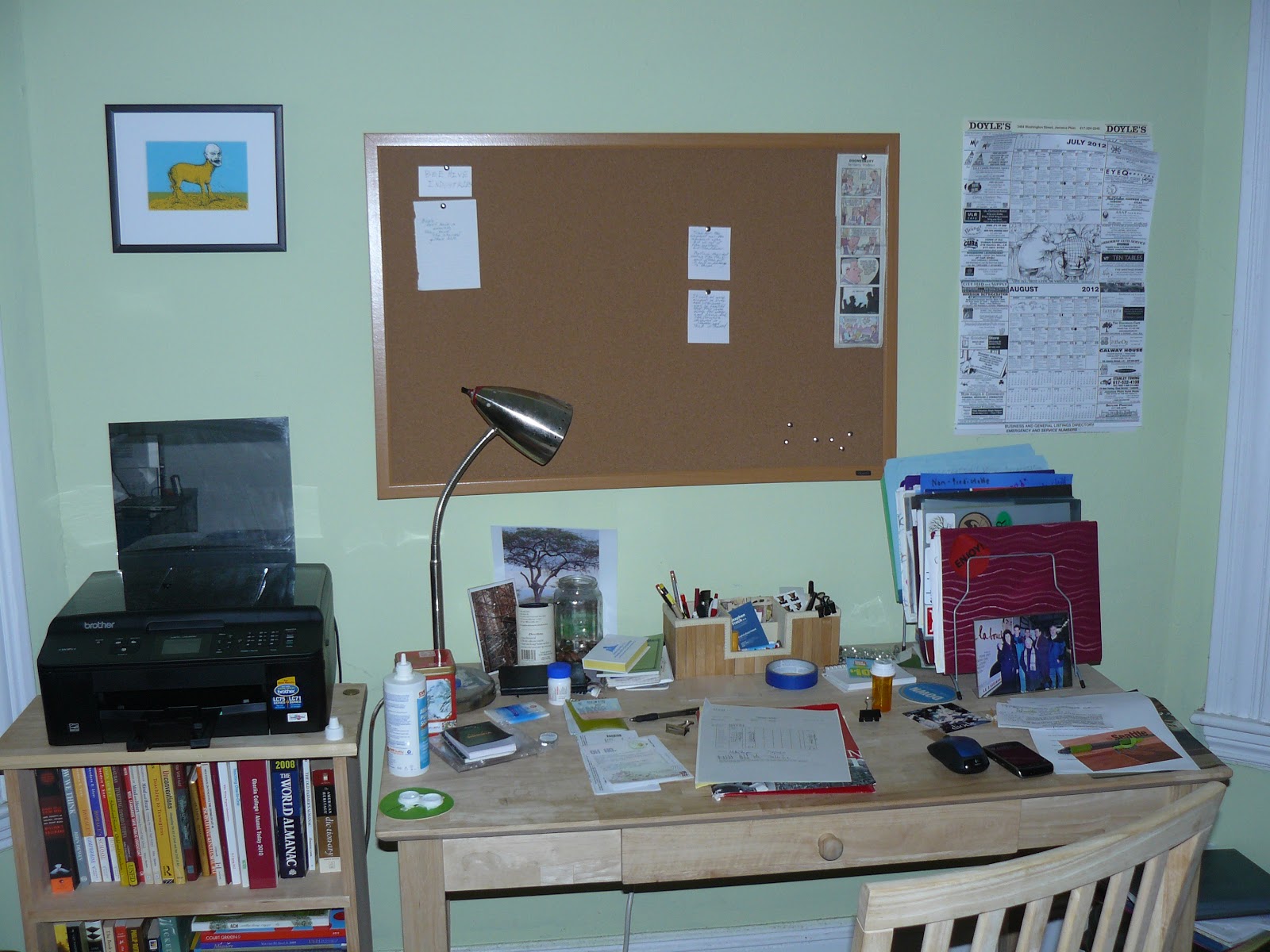
At Staples, I bought an assortment of desk-organizers, and for a while managed it in a Spartan fashion, carefully cleaning it and maintaining a clear plane of wood.  But inevitably, as a flat surface in my room, it became a landing pad for all manner of things. Even when the rest of my room is clean and clear, whether the mark of a genius, madman, or just a mix of business and laziness, my desk always has some degree of clutter signifying some of the things going on in my life.  I began taking pictures with my camera (which since my first decent smartphone-with-camera gets little use and usually sits on my desk), as it occurred to me and without cleaning or alteration, at the rate of roughly one every month.

I'm writing now from my brother's desk, which since my Mom took over his room as an office a couple years ago, has been in my room.  Now it's the home to an assortment of whale-bone and stone Inuit sculptures popular in Canada and when my parents were married in 1970, the family menorah (a piece by Ken Pick), and as long as I'm in Amherst, a few of my things (the book is an omnibus of the last two of the Long Price Quartet, which I highly recommend).   When I get back to Boston, I'll take the year's final picture of my desk.  I still long for a fancier desk, and I'm torn between it's current flawless au naturel state and lack of finish, and something more warm and worn, but it's still a biography of my life, from the times when it, and in fact my mind, were in too much turmoil to build and be industrious, to those days when its chaotic curation seemed the perfect setting to start a poem or finish an essay.

My final desk shot of the year will have to wait till I get back to Boston, but here, at nearly the very end of the year, are some shots of my desk and work area over the course of 2012, as well as my brother's desk (or is it mine now?). . .


one of my favorite sections of my brother's desk; you can't fake these stains.


Monday, December 3, 2012

November and Beyond

Well, November was a busy month.

I left my job as the Lead Writing Specialist for Foundation Year at Northeastern University, and started as Tutor Coordinator for the College of Professional Studies.  I'm sad to leave my students in FY, but excited at the opportunity to help hundreds more in an administrative role.

I also went to Poland with my family for Thanksgiving.  We ate a large number of perogies, wandered the streets of the Kazimierz District, had some very moving outings to Holocaust related sites such as Auschwitz-Birkenau and the Oskar Schindler factory, and visited many synagogues, such as the Tempel Synagogue in Krakow pictured here.


The month was so busy that I never got around to posting anything, and aside from that personal update, I also had a piece publish by The Destroyer, which deals in Post-apocalyptic Paper-mache.  It begins

Every hungry, you stumble upon the ruins of a paper factory ...

Here's hoping that you never look at candy buttons quite the same way again.

Wednesday, October 17, 2012

Whole Binders Full of Women

Inspired by Mitt Romney
For more of this ilk visit: Binders Full of Women

Friday, October 5, 2012

Bloom's Taxonomy of Art

Several weeks ago, for online professional development, I was required to create a Syllabus based on the Course Plan I developed around the 4 Cornerstones of Curriculum (methodology, outcomes, assessment, evaluation) and Bloom's Taxonomy. I decided to abandon my original, gleeful plan to develop a "Poetry for Professionals" course for a variety reasons. . .

First, I couldn't decide whether I wanted it to be an English course, a Creative Writing course, or some hybrid creature.  My sense is that it would have been relatively easy to develop as an English course, but as a creative writing course (what I was leaning toward) I think I may have run into some difficulty with the 4 cornerstones.  Particularly in the writing of *poetry*, the determination of outcomes, as well as the method of evaluation seem like thorny subjects.

I've been familiar with Bloom's Taxonomy since high school, when I completed my Senior Project on "The Perfect Public High School," but once I became, in college, a "Creative Writing Major," I stopped thinking about its ramifications.  I wonder, if on close inspection, Bloom's Taxonomy collapses in on itself when used to discuss poetry. 

In a good poem many different cognitive levels overlap, making outcomes difficult to determine.  Additionally, Evaluation seems like a near impossible task, except on a personal and highly subjective level.  Louise Gluck is a Pulitzer Prize winning poet, but I've never liked her work.  I love Gertrude Stein's Tender Buttons, but by compositional standards the "essay" or "prose poem" (the jury is still out on which it is) "Roast Beef" would very likely fail (I can imagine a letter of analysis for any section of Tender Buttons could be its own Creative Nonfiction writing exercise). 

What do you think? Can Bloom's Taxonomy be applied to fine art? What about a Jackson Pollack mural?  Are the 4 Cornerstones of Curriculum applicable to a Creative Writing Course?