Wednesday, December 26, 2012

A Year of My Desk


When I was quite young I coveted my older brother's desk.  Partly, I'm sure, it was because he had one and I didn't.  But I was an industrious child, constantly building something, and I recognized, while I couldn't read or write, that the desk was a very personal place of industry: a private shrine to self-generated creation. When I saw my brother working with pen or pencil to a notebook at his desk, I knew that something was being built, something significantly more enduring than the block towers that were made with the knowledge that they would soon be knocked down, and more secretive than the bright Lego buildings that I displayed in my room.

 My first desk was made of particle board and a gray laminate.  It had two drawers, was extremely heavy, and I used it with pride.  In college and then in graduate school I also had particle board and laminate desks, which were sturdy, but never satisfying.  My brother (and Dad) worked at heavy hardwood tables.  The pattern of the wood grain felt more honest.  The surface of my Dad's, a mid-century-modern behemoth weighing roughly a ton, was flawless and smooth, while my brother's, which I liked more, was deeply grained, stained, scratched, stamped, and hand-engraved by sharp pen nibs.  It had the patina of use and it was fascinating as an artifact: a nearly decipherable Rosetta stone to my brother's homework, creativity, and mind. 

When I moved to Boston in 2009, for over a year I had no desk.  When I felt the need, I worked sitting on an ottoman at a barely-held-together and abandoned coffee table which I had rescued from
a dark and musty portion of the basement.  It was perfect, because it was free, but otherwise I hated it.  I went with my housemates to IKEA a couple times over that year, but I was only interested in one kind of desk: wood, and most of what I found at IKEA was the same laminate I grew up with.  I wandered Crate & Barrel and Pompanoosic Mills, staring longingly at the desks of exotic tropical woods and battered reclaimed materials, like the one made from the wood of telephone poles .  The following year, when I had a little more money, I at last bought a cheap, but serviceable and honest hardwood desk from the Mill Store(s).


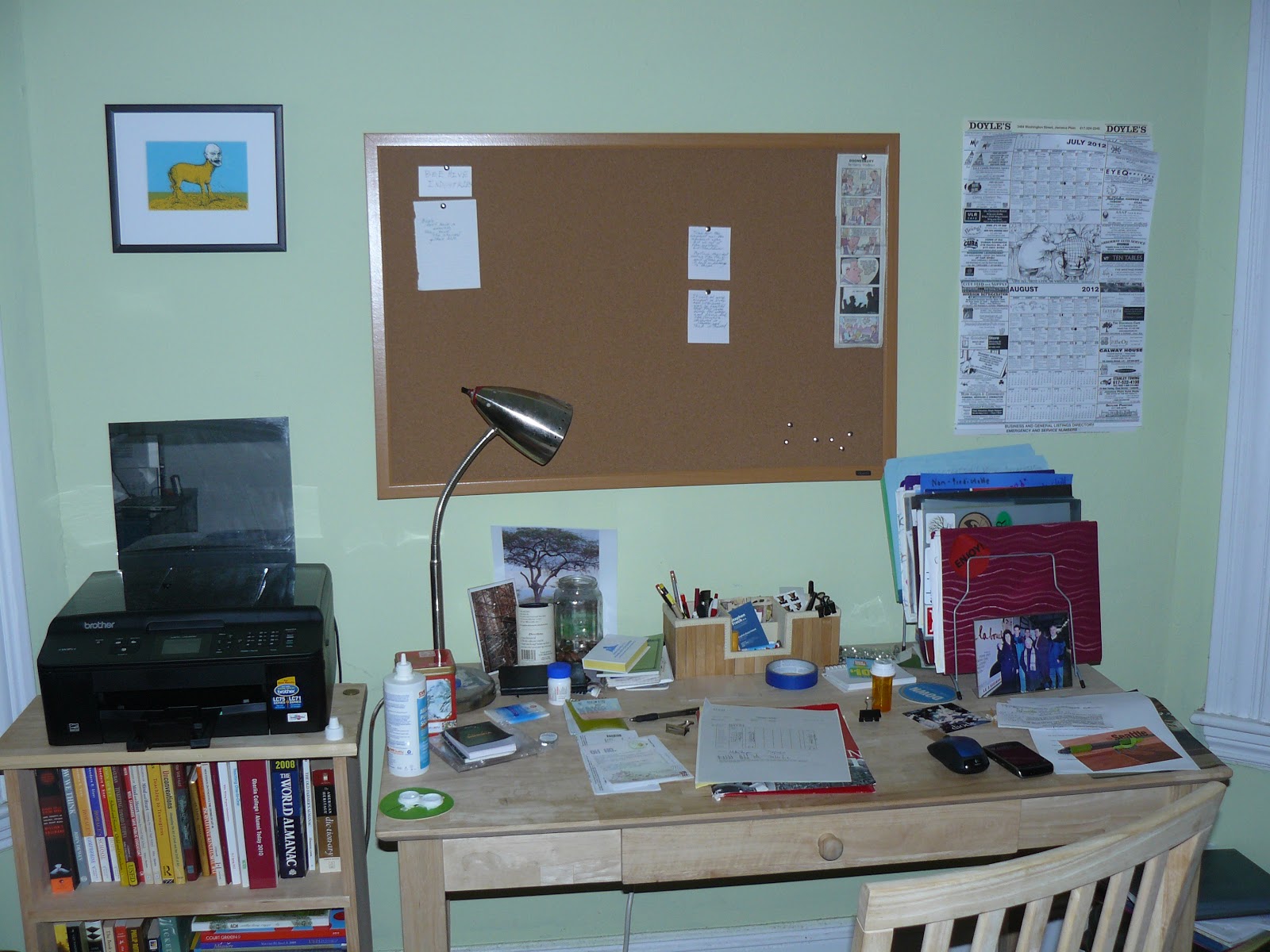
At Staples, I bought an assortment of desk-organizers, and for a while managed it in a Spartan fashion, carefully cleaning it and maintaining a clear plane of wood.  But inevitably, as a flat surface in my room, it became a landing pad for all manner of things. Even when the rest of my room is clean and clear, whether the mark of a genius, madman, or just a mix of business and laziness, my desk always has some degree of clutter signifying some of the things going on in my life.  I began taking pictures with my camera (which since my first decent smartphone-with-camera gets little use and usually sits on my desk), as it occurred to me and without cleaning or alteration, at the rate of roughly one every month.

I'm writing now from my brother's desk, which since my Mom took over his room as an office a couple years ago, has been in my room.  Now it's the home to an assortment of whale-bone and stone Inuit sculptures popular in Canada and when my parents were married in 1970, the family menorah (a piece by Ken Pick), and as long as I'm in Amherst, a few of my things (the book is an omnibus of the last two of the Long Price Quartet, which I highly recommend).   When I get back to Boston, I'll take the year's final picture of my desk.  I still long for a fancier desk, and I'm torn between it's current flawless au naturel state and lack of finish, and something more warm and worn, but it's still a biography of my life, from the times when it, and in fact my mind, were in too much turmoil to build and be industrious, to those days when its chaotic curation seemed the perfect setting to start a poem or finish an essay.

My final desk shot of the year will have to wait till I get back to Boston, but here, at nearly the very end of the year, are some shots of my desk and work area over the course of 2012, as well as my brother's desk (or is it mine now?). . .


one of my favorite sections of my brother's desk; you can't fake these stains.


Monday, December 3, 2012

November and Beyond

Well, November was a busy month.

I left my job as the Lead Writing Specialist for Foundation Year at Northeastern University, and started as Tutor Coordinator for the College of Professional Studies.  I'm sad to leave my students in FY, but excited at the opportunity to help hundreds more in an administrative role.

I also went to Poland with my family for Thanksgiving.  We ate a large number of perogies, wandered the streets of the Kazimierz District, had some very moving outings to Holocaust related sites such as Auschwitz-Birkenau and the Oskar Schindler factory, and visited many synagogues, such as the Tempel Synagogue in Krakow pictured here.


The month was so busy that I never got around to posting anything, and aside from that personal update, I also had a piece publish by The Destroyer, which deals in Post-apocalyptic Paper-mache.  It begins

Every hungry, you stumble upon the ruins of a paper factory ...

Here's hoping that you never look at candy buttons quite the same way again.

Wednesday, October 17, 2012

Whole Binders Full of Women

Inspired by Mitt Romney
For more of this ilk visit: Binders Full of Women

Friday, October 5, 2012

Bloom's Taxonomy of Art

Several weeks ago, for online professional development, I was required to create a Syllabus based on the Course Plan I developed around the 4 Cornerstones of Curriculum (methodology, outcomes, assessment, evaluation) and Bloom's Taxonomy. I decided to abandon my original, gleeful plan to develop a "Poetry for Professionals" course for a variety reasons. . .

First, I couldn't decide whether I wanted it to be an English course, a Creative Writing course, or some hybrid creature.  My sense is that it would have been relatively easy to develop as an English course, but as a creative writing course (what I was leaning toward) I think I may have run into some difficulty with the 4 cornerstones.  Particularly in the writing of *poetry*, the determination of outcomes, as well as the method of evaluation seem like thorny subjects.

I've been familiar with Bloom's Taxonomy since high school, when I completed my Senior Project on "The Perfect Public High School," but once I became, in college, a "Creative Writing Major," I stopped thinking about its ramifications.  I wonder, if on close inspection, Bloom's Taxonomy collapses in on itself when used to discuss poetry. 

In a good poem many different cognitive levels overlap, making outcomes difficult to determine.  Additionally, Evaluation seems like a near impossible task, except on a personal and highly subjective level.  Louise Gluck is a Pulitzer Prize winning poet, but I've never liked her work.  I love Gertrude Stein's Tender Buttons, but by compositional standards the "essay" or "prose poem" (the jury is still out on which it is) "Roast Beef" would very likely fail (I can imagine a letter of analysis for any section of Tender Buttons could be its own Creative Nonfiction writing exercise). 

What do you think? Can Bloom's Taxonomy be applied to fine art? What about a Jackson Pollack mural?  Are the 4 Cornerstones of Curriculum applicable to a Creative Writing Course?

Sunday, September 30, 2012

Three prose poems in [a] Ditch


This week, a Canadian literary journal online, Ditch, the poetry that matters, published three of my pieces.

I'm particularly excited to have them come out this week, because the first two, "Flutters" and "Midnight of the Caramel Eaters," are late-summer to autumn to winter pieces (albeit in somewhat reversed order).  They will help you bridge the gap from the recently departed summer, through to the inevitably of winter. 

The last piece, "Sprout," is something different.  I suppose one could call it a "spring" poem, because it ends with the possibility of growth, but it's open-ended as to whether this is the sort of growth you'd want. 

Take a gander at them here.

Wednesday, September 12, 2012

Literary Death Match, Boston Ep 9

Tonight, and tonight only, I will be reading with a star-studded cast of literary luminaries at Club Oberon for the 9th Literary Death Match, Boston edition.

Tickets are $12 in advance or $15 at the door.


Thursday, August 30, 2012

Names, Words, Success, and Acronyms

            In an apocryphal anecdote, Cole Porter's mother added a singular "A" to Cole Porter's name because she had heard that people whose name spelled a word were more successful in life.  If there is indeed that much power in the initials of a name we may be left to wonder how much intentional or coincidental gematriya was employed in the selection of the center initial.  If we assume that Ms. Porter was set on both the name "Cole" and wanted her son to have only three initials then she would only have had two options, "A" and "U."  By going with "A" she chose the first letter of the alphabet, perhaps indicating that she wanted her son to be "first" in whatever he did.  But she also chose a far more common letter and ladled her son with a seemingly symbolically unremarkable name. 

            By the same standards my own name dooms me to insignificance, but perhaps not as extreme as my parents LMF, NPF, or my brother, DJF.  My brother currently has nearly 18000 followers on twitter.  Imagine how many he could have if my parents had the foresight to make sure his middle name started with “a” (daf: a Persian drum resembling a tambourine, but without the cymbals).  My Uncle Steve, accepted as a success within my family and the statistician community, has the only set of initials with a readily pronounceable unit; SEF. 

A cursory check of Forbes’ top 100 most wealthy people for 2012 indicates that not a single one of those billionaires has a name which spells a word.  Of course there are many other indicators of success which are measured in more elusive individual ways.  For instance, I was unable to find a list of the top 100 happiest people in the world, or the most satisfied.  No certain conclusions can be drawn from this list.  The survey of the forbes list indicates that whether your name represents an esteemed acronym, common word, or even, a clean slate, success is still a possibility.  Clearly there are possibilities for further research.

Choice acronyms for each of my family members presented in alphabetical order, followed by the total number of acronyms (as listed on acronyms.thefreedictionary.com):

DJF - Daniel James Fienberg

Divorced Jewish Female
Djibouti Franc (ISO currency code)

Total: 2

LMF - Lorne Michael Fienberg

Lacking Moral Fiber
Library Management Facility
Light Manufacturing Facility
Logical Mainframe
Lutheran Ministries of Florida

Total: 15

NPF - Nona Paula Fienberg

National Park Foundation
National Peanut Festival
Nigerian Police Force
No Problem Found
Nuclear Power Facility

Total: 24

OJF - Ori Joseph Fienberg

Online Job Facility
Order of Sir John Franklin

Total: 3