Showing posts with label writing. Show all posts

Wednesday, March 18, 2015

Against Inconsistent Typography Pendantry

Several years ago, I participated in an online forum that discussed the topic of spaces after a period.  That the “tradition” of putting two spaces after a period, as befit monotype font on typewriters, had become anachronistic thanks to font-creators for computers factoring in some extra space after the period to make up for it.  I argued that I preferred the two spaces, not because I argued against that, but for aesthetic and philosophical reasons; paragraphs get a break and an indentation, so why not give sentences a little extra breathing room to acknowledge their individuality?

Since then I’ve continued to put two spaces after the period, though a pedantic Slate article ensured that nearly everyone knows the historical basis for putting two spaces after a period, and as a result more and more people are eager to share this with me when I send an email or send a memo.  I’ve always been of the opinion that in this and other formatting peccadilloes, such as citation style, it’s more important to be consistent than to be pedantic.  Still, in more and more pieces of writing, I find myself only using one space. I still don’t feel as though the amount of space that has been allotted after the period automatically by programmers is sufficient, but I bow before the march of progress, and only continue my iconoclastic behavior in my poetry, where really anything goes.

Recently though, I wrote up a memo and sent it my supervisor for suggestions/edits and found that she had corrected another of my consistent punctuation patterns: when I use quotation marks, I put the punctuation outside the marks, unless the punctuation is part of the quote.  For example

I can’t believe that Jeff said, “punctuation always belongs inside quotes”!


It seems to me that by necessity, the exclamation goes outside the quotes: it’s my emphasis and putting it inside the quotes could make it appear that this was Jeff’s emphasis, when Jeff probably said this very casually.  I think that sort of issue makes the best case, but I’d also put the comma after the quotes in more basic grammatical situations, such as:

Americans put punctuation within quotes, according to supposed “rules”, but in fact there’s no reason to do so, and plenty reason not too.


This is a typographical peccadillo that comes up periodically, and appears to be yet another formatting topics where England, and Commonwealth countries such as Canada employ one technique, and the USA tends toward another.  I would have considered this akin to other topics, such as alternate spellings like “labor” and “labour”, where ultimately both are acceptable, and consistency is most important.  Honestly, I don’t know if my choice to put punctuation outside of the quotes is a result of having been raised by Canadian parents, or if, like two-spaces after a period, it just felt right.  To me, it seems obvious that the only thing that belongs inside a quote are the units of punctuation that are a part of that quotation. Partly it’s a philosophical issue, and in many cases it increases clarity, rather than creating confusion, which ought be the role of grammar and proper punctuation.

As to the title, ultimately it’s the inconsistent standards applied to punctuation that gets to me.  The pedants rail again those who use two-spaces after a period, occasionally on a scientific  basis (two spaces slows down reading: I think that’s a good thing and as it should be, but I’m apparently in the minority), and most often by trotting out the explanation about how this is an outdated practice, leftover from the time of typewriters.  

But the fact is that the American convention around placing punctuation within quotation marks is even more outdated than clinging to conventions from the days of typewriters, and instead dates all the way back to type-setting, when according to the CCC Foundation, the “.” and “,” were the most fragile metal-bits of type, and printers were worried that the piece of type may break away from the body of text, and be dented or ruined if they had the wider “”” on their right-hand side.  Therefore, printers began placing the smaller punctuation within the quotation, as means of protecting the type.  

This means that even once we began using typewriters, this convention was outdated, and doubly so in the digital age.  Unfortunately, the alt.english.usage FAQ that the CCC Foundation links to as proof of this historical basis is dead, and I have been unable to find another reference to this origin. Still, even if this story is apocryphal, the logic of not putting punctuation in quotations should win out. Even though the status quo is unlikely to change and I may still have my quotation/punctuation corrected, I will continue my current typographical practice.

Tuesday, September 30, 2014

Self-Promotion: New Homes for Poems

Last year, after submitting to literary journals at a fairly steady rate, I stopped.  Partly, I was exhausted.  Submitting is relatively easy, though it can be a pain to reformat submission after submission, but mostly it's the waiting.  Two days to a rejection with no explanation.  Four months to hear from an editor that several readers liked it, but then decided it wasn't for them.  Additional work sent to editors who praised a submission, but requested something slightly different, only to take six months to reject it with zero feedback.  Sometimes, an editor or readers likes a piece enough to accept it.  Sometimes they like a few.

As it turned out, I was just successful enough, so that I only had a handful of poems left, and most of them, even the ones I loved, felt a little stale.  Like a marshmallow.  Still good for roasting, and sort of pleasant in its chewiness, but not always the best kind.  So last year I started going to the Boston Public Library in Copley Square to write, and did not submit at all: I ended the year with a sack of new poems, ready for s'mores (or some other confusing metaphor).  Then I began to submit, and racked up a handful of acceptances, usually a combination of fresh and the old, chewy ones.

In just the last week I've had pieces in three fine places.  Perhaps you find yourself here, because you found me in one. In any case, thanks to BOAAT Press, Pretty Owl Poetry, and Storyacious for providing homes for my poems, and to Boaat and Storyacious for the nifty illustrations! Paper Darts, who published a few of my pieces a couple years ago, still takes the cake for best accompanying artwork, but I do like when journals provide you with additional stimulation.

Here they are:

BOAAT - Unexpected Delays and Small Comfort
The food court is a desert, undergoing renovations, and the fast food burger chain has run out of Happy Meals. Instead, they are selling Tragedy Meals...

Pretty Owl Poetry - Strange Shores and Memories of Water
A man’s head was filled with water. In summery months it teemed with glittering fish-like thoughts that he’d lure with the subtle bait of meditation...

Storyacious - Lightbringers
They kept their angel chained to a post in the subdivision. Its song was so beautiful, all the birds left town in shame...


Stay tuned for more publications and random musings in October!

Tuesday, July 2, 2013

A Composition of Food

When I write, I don't choose the form or the words based on a particular formula; instead, I usually build a piece around one core ingredient, a singular line, or the protein of the piece.  The rest I fill in according to what feels right.

I carry the same philosophy into cooking (or maybe it's vice versa?).  I enjoy reading cookbooks on ocassion, but I very rarely choose a recipe, then buy the ingredients, and then follow the directions.  Instead, I build a meal around one core ingredient, usually the protein, and then make something up.

I've been doing this pretty much since I discovered that I enjoyed cooking in high school (reading Simon Ortiz' great poem/narrative/recipe "How to Make a Good Chili Stew..." probably also had something to do with it).  Sometimes, I fail spectacularly, usually because I forget an ingredient and/or when I start putting things together I realize I have a fraction of what I need and then improvise.  But as I've been using this approach to cooking for over a dozen years now, I've had fewer and fewer misses.

Now the main drawback is the same whimsy that leads to some of my greatest success: I'll get the idea to add something a little different to a recipe, for instance unsweetened chocolate and coffee in chili, and then forget to add them the next time.  Or because I also rarely measure, except when baking, I'll forget just how much.  As a result, my greatest triumphs are usually one-offs that I'll never make again.

A couple months ago, I stepped into Kam Man by the South Bay Plaza, an Asian market in the vein of Super 88s.  This is always a great place for a little departure from my ordinary food routine, or some random inspiration.  It's also a great place to get less common cuts of meat (such as cow tendon, or pig tongue), or animals my Stop and Shop doesn't usually carry, like frog, squab, and duck.

They were having a boffo sale on whole (cleaned) rabbits.  More expensive than chicken, but better than a decent steak.  So I bought one.  It languished in my freezer for a few weeks, while I considered lofty recipes.  Finally, I decided that I would slow cook it with root vegetables and some port marinated prunes.  I just needed to go to the liquor store to pick up port.

On the way to the port I passed through the brandy aisle.  Brandy has always intrigued me.  On the one hand it seems incredibly fancy.  I imagine putting on my smoking jacket, filling a snifter and swirling it thoughtful in a library of leather-bound books.  But the one time I bought it I was unimpressed.  I found it bitter and not particularly complex.  Even so, as I was walking through, a bottle of Laird's Applejack caught my eye. 


It's brandy, but made from apples (or at least with apples), and has pleasantly old-fashioned and rustic packaging.  I forgot my plans for port, and bought the applejack instead.  Then I needed another trip to Stop and Shop to find a more appropriate compliment than prunes.  And what better compliment than apples?  From there the rest of the ingredients fell into place, and when I made my dish it was a grand success, so good in fact, that I sat down and scribbled out the recipe for further use.  For a couple weeks the recipe has languished on my desk.  I just knew there was an ingredient missing, but I couldn't remember what it was.  Today I did.  Without further ado, the recipe for my Applejack Rabbit Casserole:

Marinate rabbit pieces in shallow (3-4 inches in depth) casserole dish with equal parts rice vinegar and applejack brandy. Cover in saran wrap.

Chop parsnips into one inch chunks.  Add to slow cooker.

Over parsnips, pour two mugs of chicken stock.  Add one can of diced tomatoes (I used Pastene's fire roasted)

                                          Turn slow cooker on.

Make a garlic-heavy gremolata (finely chopped garlic, parsley, lemon zest)
Peel, core, and slice 2-3 sweet apples, different kinds.  Add to slow cooker. Peel and
liberally stud one golden delicious apple with cloves.  Add to slow cooker.  Slice a few one
inch long strips of ginger, toss into slow cooker.

Drain marinade off of rabbit pieces. Sprinkle salt and pepper on rabbit pieces.  Dredge in flour.
Dice a medium sized vidalia onion.

Add a few tablespoons of olive oil and and a couple tablespoons of butter to a pan on medium
heat.  When butter has melted into oil, add half of diced onions.  Wait for onions to go
past yellow, but not quite brown.

In small batches, brown rabbit pieces in butter-oil and onions.
Reserve browned rabbit pieces and carmelized onions on tray.  Then skim darkest onions from
pan, add a little more oil and a little more butter and add remainder of diced onions.
Gradually add flour, stirring constantly.  Add gremolata. Continue to stir, as though making
a roux. When roux is just past yellow, add 25 - 50 cl applejack brandy to roux. 

Enthusiastic bubbling should commence.  Continue adding flour (roux should take on the form
of a thick gravy) and stirring until gravy no longer gives off alcohol fumes.

Pour half of gravy on apples and parsnips.  Place rabbit pieces on top.  Pour remaining
gravy on top. Add one half-inch latteral slice of lemon.

Make a bouquet garni in a small sachet.  Put the sachet in a mug, fill with water, and
microwave for about a minute.  Pour herb "tea" into slow cooker.

Cover and cook for about 1 hour.  Remove studded apple at the point when it has softened
enough to begin to lose shape, but before disintegration, and nibble before discarding. 

Continue to cook for another 1-2 hours.
-----------
Meanwhile, make the side salad...
Matchstick slice two granny apples (skin on), half a fennel bulb, and 1-2 endives. 
Mix and toss with a dressy of olive oil, lemon juice, rice wine vinegar, and a small amount
of creamy horseradish.  In a pan, toast a teaspoon of fennel seeds.  Toss together. 
(Watermelon radish would add a small pop of color and complement the flavor well).
-----------
After about two hours, turn the slow cooker off.  Lift top and remove rabbit pieces and
reserve them on a dish.  Wearing oven mitts, lift slow cooker ovenware and pour mixture into
collander to drain excess liquid.  Shake, and then pour into initial casserole dish and
place rabbit pieces on top.  Cover with tin foil and heat in oven for about 30 minutes.
-----------
Remove from heat, give 5-10 minutes to cool, then serve with side salad.

Tuesday, March 19, 2013

Submission Recession, Writing Domination

Now that I've had a little time to recover from the 2013 AWP Conference in Boston, it seems like a good time to consider the year 2012 in writing.  I participated in two readings: one at the Marliave for U35, a reading series for writers under the age of 35, and another, the highly esteemed, or at least somewhat recognizable, Literary Death Match at Club Oberon.  Out of 33 submissions, I had 6 publications, for an acceptance rate, roughly comparable to Ivy League schools, of about 18%.  One piece, "Sidekicks," published in the MidAmerican Review, was an "Editor's Choice," and a finalist for the 2011 Fineline Competition.  Two more pieces appeared in Knock Magazine, a publication that seems to have already gone under.  The rest are available online for your reading pleasure.

Paper Darts, a hip sort of design-collective/publication dolled up The Sweetness, Mirror Day, and Ride to the Top with some images that will likely be my first tattoo.

Ditch, a Canadian journal of poetry, published Flutters, Midnight of the Caramel Eaters, and Sprout.

Then Punchnel's put up Gibbous.

And The Destroyer offered my one and only poem (or is it fiction?) in the second person: Animus.

Finally, towards the end of the year, Fjords Review accepted two pieces, and curiously decided that despite having submitted those pieces as prose poems, that I would be listed not as a contributing "poet," like nearly everyone else in the issue, but as a "writer." 

This continues the very incremental upward trajectory of my submission acceptances. In 2012, I focused my attention on online publications, and submitted to online venues that seemed like they might have a slightly different audience from places I've had work in the past. 

This year, I sense a submission recession has set in.  Seeing the last of the worthy poems I wrote in college published has made me somewhat introspective, and as a result I've been focused on writing more (which is a perennial New Year's resolution).  So far, I've maintained a far steadier pace then I have in several years.  There's still plenty of time left in 2013, but my hope is that even if I don't make a single submission this year, I'll be building up my war chest of poems in anticipation of a bumper year in 2014.

Wednesday, December 26, 2012

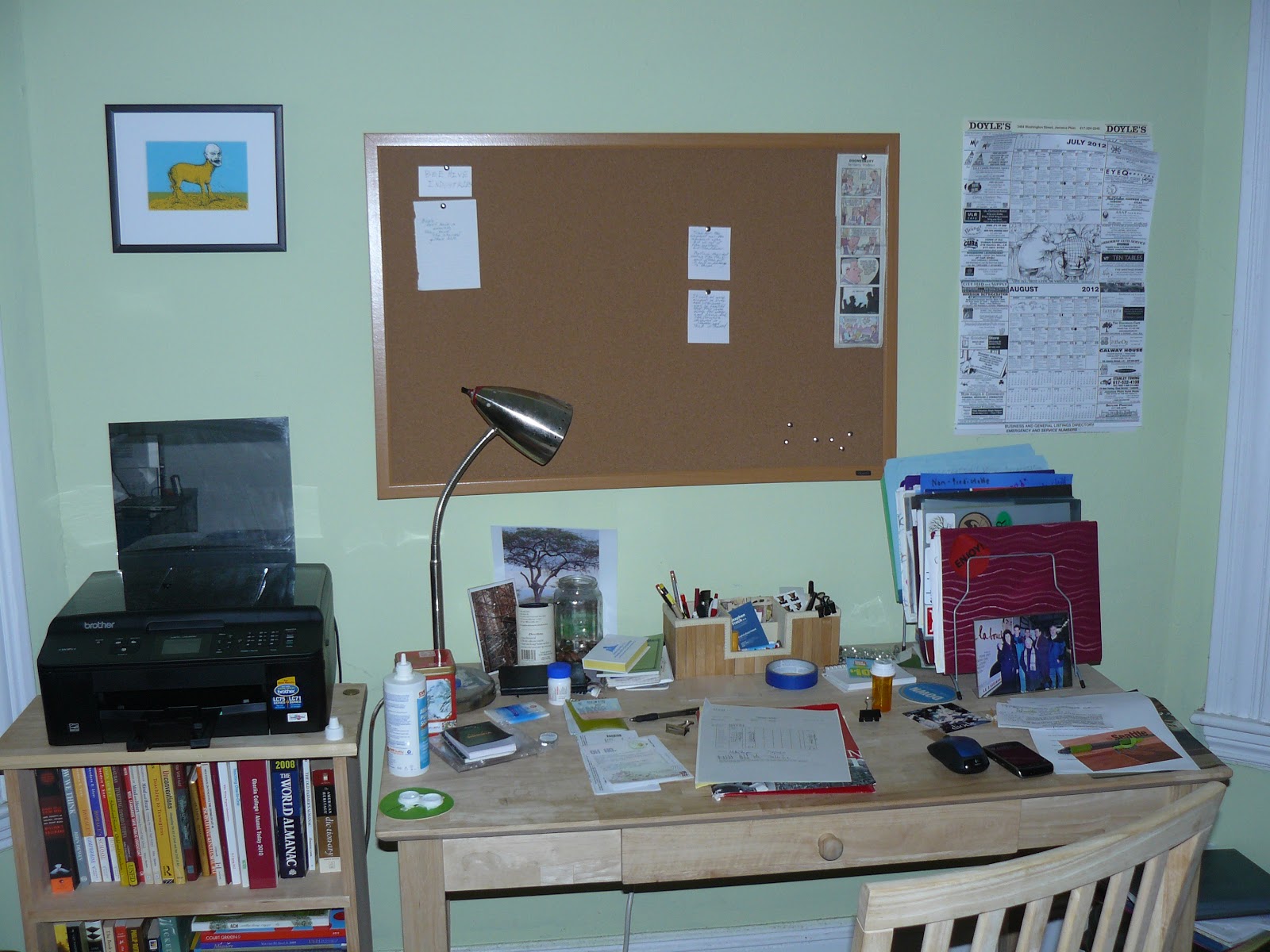
A Year of My Desk


When I was quite young I coveted my older brother's desk.  Partly, I'm sure, it was because he had one and I didn't.  But I was an industrious child, constantly building something, and I recognized, while I couldn't read or write, that the desk was a very personal place of industry: a private shrine to self-generated creation. When I saw my brother working with pen or pencil to a notebook at his desk, I knew that something was being built, something significantly more enduring than the block towers that were made with the knowledge that they would soon be knocked down, and more secretive than the bright Lego buildings that I displayed in my room.

 My first desk was made of particle board and a gray laminate.  It had two drawers, was extremely heavy, and I used it with pride.  In college and then in graduate school I also had particle board and laminate desks, which were sturdy, but never satisfying.  My brother (and Dad) worked at heavy hardwood tables.  The pattern of the wood grain felt more honest.  The surface of my Dad's, a mid-century-modern behemoth weighing roughly a ton, was flawless and smooth, while my brother's, which I liked more, was deeply grained, stained, scratched, stamped, and hand-engraved by sharp pen nibs.  It had the patina of use and it was fascinating as an artifact: a nearly decipherable Rosetta stone to my brother's homework, creativity, and mind. 

When I moved to Boston in 2009, for over a year I had no desk.  When I felt the need, I worked sitting on an ottoman at a barely-held-together and abandoned coffee table which I had rescued from
a dark and musty portion of the basement.  It was perfect, because it was free, but otherwise I hated it.  I went with my housemates to IKEA a couple times over that year, but I was only interested in one kind of desk: wood, and most of what I found at IKEA was the same laminate I grew up with.  I wandered Crate & Barrel and Pompanoosic Mills, staring longingly at the desks of exotic tropical woods and battered reclaimed materials, like the one made from the wood of telephone poles .  The following year, when I had a little more money, I at last bought a cheap, but serviceable and honest hardwood desk from the Mill Store(s).


At Staples, I bought an assortment of desk-organizers, and for a while managed it in a Spartan fashion, carefully cleaning it and maintaining a clear plane of wood.  But inevitably, as a flat surface in my room, it became a landing pad for all manner of things. Even when the rest of my room is clean and clear, whether the mark of a genius, madman, or just a mix of business and laziness, my desk always has some degree of clutter signifying some of the things going on in my life.  I began taking pictures with my camera (which since my first decent smartphone-with-camera gets little use and usually sits on my desk), as it occurred to me and without cleaning or alteration, at the rate of roughly one every month.

I'm writing now from my brother's desk, which since my Mom took over his room as an office a couple years ago, has been in my room.  Now it's the home to an assortment of whale-bone and stone Inuit sculptures popular in Canada and when my parents were married in 1970, the family menorah (a piece by Ken Pick), and as long as I'm in Amherst, a few of my things (the book is an omnibus of the last two of the Long Price Quartet, which I highly recommend).   When I get back to Boston, I'll take the year's final picture of my desk.  I still long for a fancier desk, and I'm torn between it's current flawless au naturel state and lack of finish, and something more warm and worn, but it's still a biography of my life, from the times when it, and in fact my mind, were in too much turmoil to build and be industrious, to those days when its chaotic curation seemed the perfect setting to start a poem or finish an essay.

My final desk shot of the year will have to wait till I get back to Boston, but here, at nearly the very end of the year, are some shots of my desk and work area over the course of 2012, as well as my brother's desk (or is it mine now?). . .


one of my favorite sections of my brother's desk; you can't fake these stains.


Monday, December 3, 2012

November and Beyond

Well, November was a busy month.

I left my job as the Lead Writing Specialist for Foundation Year at Northeastern University, and started as Tutor Coordinator for the College of Professional Studies.  I'm sad to leave my students in FY, but excited at the opportunity to help hundreds more in an administrative role.

I also went to Poland with my family for Thanksgiving.  We ate a large number of perogies, wandered the streets of the Kazimierz District, had some very moving outings to Holocaust related sites such as Auschwitz-Birkenau and the Oskar Schindler factory, and visited many synagogues, such as the Tempel Synagogue in Krakow pictured here.


The month was so busy that I never got around to posting anything, and aside from that personal update, I also had a piece publish by The Destroyer, which deals in Post-apocalyptic Paper-mache.  It begins

Every hungry, you stumble upon the ruins of a paper factory ...

Here's hoping that you never look at candy buttons quite the same way again.

Monday, July 30, 2012

Declaration of Independence: On reading and the rights of children


When I was in preschool, while I was still having trouble expressing myself with words, I daydreamed constantly.  I sat out during our recess and watched the girls on the swing-set.  I didn’t know how to swing.  I didn’t know how to ask and no one had thought to teach me yet.  Already I was starting to see gender divides.  Every day, boys wrestled, and hit each other with sticks, and put strange things into their mouths until someone with authority noticed and stopped them.  On the other hand, the girls made immediately for the swings, as though drawn by some inner-magnetism.  They got on the swings and didn’t stop until someone blew the whistle to end recess.  This hidden knowledge frustrated and also exhilarated me.   I would just stare as the enlightened few went up and down, smiling and giggling in the air, never realizing their power, and I would imagine them changing in midair to birds and flying away.  This is the first time I can remember desiring knowledge: till I had seen girls in flight, I’d never considered how my lack of knowledge kept me bound to the ground.  I learned to ask questions, and did, constantly, about everything.

Around four years old, I had a favorite game I’d play with my mother.  I combined letters and then asked her if they were words.  This could keep me preoccupied for ages. Most of the time it was pretty easy for her; I hadn’t quite figured out the important difference between vowels and consonants and how to connect the two for phonemes, let alone words.  I kept her on her guard though: every now and then I’d memorize the spelling of one word.  We’d start as usual: I’d reel off several strings of letters.  Every now and then I’d toss out one of the words I knew, almost exclusively of the three-letter variety, then I would lull her into complacency with one barrage of useless letters after another.  Finally, I’d say “What about E-S-T-U-A-R-Y… Is that a word?” smiling to myself, knowing full well the answer (while having no idea what the word meant).  I didn’t do it too often, and invariably my mother would stop in her tracks and turn to me.  Cunning little plagiarist that I was, I only cited a source once.  When my mom learned that I had seen it on a book, she smiled, explained the word and that was the end. . .  but when I acted as though I had stumbled upon it, catching a word flying through the air, she treated the it as a talisman, and me as a wunderkind.  Already I had begun to learn that words and books held tremendous, secret power, but it was another struggle, much like learning to speak, to unlock it. 

Reading was very difficult for me.  I knew the letters, but I didn't see them as tools or friends.  They were confusing and contradictory.  The school was using an unofficial version of Hooked on Phonics that focused not on the phonemes, but on the teachers constantly repeating one phrase, "Sound it out.  Just sound it out!" The sounds didn't make sense to me.  There were so many rules I thought the teachers were making them up.  For instance, I couldn't figure out why "bread" was pronounced "bred" and not "breed" when "reading" was pronounced "reeding".  On top of that, I had a small speech impediment: I couldn't say "S"s at the beginning of sentences.  I used to lie in my bed at night and repeat "squirrels have tails, girls have curls, squirrels have tails, girls have curls."  I knew, but getting the “s” on the “quirrel” was very hard. 

The school responded by putting me in the "slow class".  That was actually its name.  We had to wear huge, avocado-green headsets and listen as a proper, lightly-accented British woman read words to us while we looked at them simultaneously on the page.  Most of the time, I did the same thing all of my report cards said: I spaced out. I daydreamed.  I thought about what it would be like to have wings, or bounce when I fell off the jungle gym.  I worked with my parents on reading, but it was no fun, and in homeroom I looked at the mass of letters like an incomprehensible war on the page and said "I can't". If the teacher tried to prod me further, I started to cry.

This kept up until 2nd grade when I had Ms. Beck.  She wouldn't take "no" for an answer.  She acknowledged that it was hard, and that sometimes it didn't seem to make sense, but she told me that I wasn't allowed to say "I can't" or "I don't know" anymore.  She introduced me to "The Little Engine That Could" and I slowly learned to “sound out” words and recognize and remember the ones that couldn't be sounded out. My mantra became "I think I can, I think I can."  Sometimes I still couldn't, but there were fewer tears, and instead of a war, I saw the letters on the page as a mountain that I was chugging my way up.

I didn’t know it at the time, but “I think I can, I think I can” was my declaration of independence.  Once I could read, I took charge of answering my own questions.  All the time I’d previously spent daydreaming in class, I used to read.  I read in English.  I read in Math.  I read in Science.  During school I usually just read ahead in my class textbooks, but my favorite books were stories with lessons or hidden meanings that would give me something to worry at as I fell asleep.  I devoured folklore. I memorized a book of Aesop’s Fables.  Then D’Aulaires’ Book of Greek Myths.  And I retold the stories at sleepover camp, in front of the fire, and I realized that while ordinarily I was a shy child, desperate to please authority figures, when I told stories, I was in charge.  The story was mine to command, with everyone’s attention and even respect hanging on my every word.  I was the magician.  I controlled flight and I could free people from the bonds they couldn’t see.
                                                                                                                             
These experiences indicate the importance of two articles in The Convention on the Rights of the Child.  First, article 14, which “respect[s] the right of the child to free thought,” and  second, article 28, which “recognize[s] the right of the child to education.”  These truths I took to be self-evident, along with one other right that served as the central braid connecting education and freedom in my story; however, The Convention on the Rights of the Child does not include it: independence.  Development of, and respect for, my independence as a learner, were the two most important rights granted to me as a child. 

The only time the word “independence” is even used in The Convention on the Rights of the Child is to refer to a nebulous and vaguely nefarious sounding “independent and impartial authority.”  The first things a child is taught are rules, and for most children, the most important rule is that adults are the “authority," and swiftly thereafter they learn that adults’ authority, for better or for worse, is in no way impartial.  Children are told to “do as I say, not as I do.”  They see one set of parents ignore their child’s behavior; meanwhile, they are chastised by their own parents for crimes they don’t fully understand.  Meanwhile, in school, teachers tell students to push themselves, but punish them with bad grades if they fail to do anything other than what the teacher feels is right.  Nearly every child will experience the aforementioned types of authoritarianism and unfortunately, in many cases it will be far worse.  Indeed, it is no mistake, but a sad indictment of prevailing attitudes towards children, that in the US, when a child wishes to conduct their own business, they must become “emancipated,” as though previously they were oppressed.  The small injustices children face at the hands of well-meaning authority figures is nothing compared to the abuse they can be subjected to as dependents of adults who care nothing for their rights.

One of the early propositions of the declaration is "that the child should be fully prepared to live an individual life in society," but a student who only learns what not to do and is dependent on authorities for all learning has little chance of living an individual life.  For this and the aforementioned reasons, failing to include a provision among the 54 articles the UN proposes for “the right of the child to independence” is either a distressing gap, or a call to children everywhere.  The rights that are given to you by authorities keep you at the mercy of authorities; however, the rights you declare, by educating yourself and exercising your freedom to express yourself become a part of you and cannot be taken without a fight.

Friday, April 6, 2012

Differing Opinions on John Storer


*Architect Sketch of John Storer House

Sometimes, I like to go surfing. I'm somewhat lacking in balance and live on the East Coast, so I of course mean wikisurfing. Oh, the times I've had; the pub-quiz trivia knowledge I've gained! Sometimes though, I stumble across discrepancies, especially when it comes to tangential people in history.

John Storer had his home, of Frank Lloyd Wright's textile-block-house era, built for him in 1923. There's precious little information offered about him on Wikipedia. One spot is in the Millard House entry, while another is in the John Storer House entry. In both articles he is described as a "doctor," yet in one he's described as "homeopathic" and in the other he is described as "failed." The former entry cites Ruth Ryan, a former Celebrity Homes Columnist," but does not provide an active link to the article. Meanwhile the latter does: Hugh Eakin's article is a riot of adjectives; tempestuous, obsessed, untested, free-spirited, and motley, all make appearances in the first two paragraphs of the article, along with rhetorical questions and broad cinematic pronouncements; I can't help but distrust it: there are just too many adjectives to wrangle with.

So my question is, who's right? Or are they both right/wrong? Was he a successful homeopathic doctor, but not a "real" doctor, and thus a failure? Or did he turn to homeopathic medicine after failing to make it as a conventional doctor? Or something completely different?

Searching for "John Storer" and "Frank Lloyd Wright" together on Google returned 9,370 results, but it took till page three to find a substantive article here.

The article is from a series Young calls "Biographies of Homeopaths" (I will, for the purpose of inquiry accept "homeopathy" as medicine), and further down the page she also writes that John Storer was a professor and Dean of The Hahnemann Medical College of Chicago. Hey, professor and Dean (just like my Mom!), that doesn't sound much like "failed" to me. And if like me, you think the failure Eakin refers to may be the mere practice of "homeopathic" medicine, then this article, cited by Young, becomes especially helpful in gauging if not the legitimacy of homeopathic medicine, at least the status of homeopathic medicine in Chicago around the time The Hahnemann Medical College of Chicago was founded.

With a little historical perspective, and with Dr. John Storer's titles, I hope that's not what Eakin is referring to. And anyway, let's remember that at the time (or even sometime after) Dr. Storer moved into his house in 1923, Heroin Cough Drops, Benzedrine Asthma Inhalers, and Lobotomies for Depression were all accepted medical practice.

So, if "homeopathy" isn't what Eakin was referring to at all, what could he be basing his adjective choice on? Another answer emerges when you read deeper into Young's article, as she suggests that Dr. Storer went bankrupt because of the cost of the home. Here the linked source is within a book, Frank Lloyd Wright's California Houses by Carla Lind, which states in the sidebar on the right that Dr. Storer died bankrupt in 1927. The 6 reviews of Carla Lind's books on Amazon are somewhat inconclusive. A few say the books are great, and a few say they're thin and slight on information. That sort of statement makes me doubt that they include a work cited, and I'm not about to buy the book just to find out, which means that without some extra work I can't confirm the possibly sad fate of Dr. Storer.

Regardless, while "failed doctor" adds the flair of desperation to the "motley" bunch that Eakin assembled, and while in assessing his lot at the end of life it's possible that Dr. Storer considered himself a failure, it just doesn't seem like a fair phrase because it implies that Dr. Storer failed "as a doctor," and ultimately, unless other evidence can be presented to contrary, misrepresents the man...

Anyway, if anyone has more information about Dr. John Storer, do let me know.

---------------------------
Differing Opinions of Dr. John Storer

Found at http://en.wikipedia.org/wiki/Storer_House_(Los_Angeles,_California)

The Storer House was built in 1923 for Dr. John Storer, a homeopathic physician.

Source: Ruth Ryon (2001-02-03). "Home of the Week: Restoration Has All the Wright Detail". Los Angeles Times.

About Ruth Ryon: http://en.wikipedia.org/wiki/Ruth_Ryon


Found at http://en.wikipedia.org/wiki/Millard_House

As The New York Times later said of the California houses built by Wright in the 1920s: "It didn’t help that he was obsessed at the time with an untested and (supposedly) low-cost method of concrete-block construction. What kind of rich person, many wondered, would want to live in such a house? Aside from the free-spirited oil heiress Aline Barnsdall, with whom he fought constantly, his motley clients included a jewelry salesman, a rare-book dealing widow and a failed doctor."

Source: Hugh Eakin (2005-08-14). "Fixer-Uppers That Need Love and Concrete". The New York Times.

About Hugh Eakin: http://www.nybooks.com/contributors/hugh-eakin/

Sunday, April 1, 2012

Call For Submissions: Cartographie Curieux


Greetings Friends, Acquaintances, One-Night Stands, Frenemies, Editors, Classmates, Professors, Colleagues, and everyone else,

We are pleased to present a call for submissions from our new Web Journal: Cartographie Curieux. Cartographie Curieux is interested in the curious geographies that everyone must navigate as they travel through life. We are obsessed with finding ourselves and we are looking for some good maps to get us there. We think you may be (or know) one of the talented cartographers we are looking for: please send us submissions of any kind: poetry, fiction, nonfiction, interviews, and of course, images which engage with the idea of maps. Surprise us!

Check Out Our Nascent Website: ttp://www.cartographiecurieux.com

And LIKE us on Facebook: http://www.facebook.com/CartographieCurieux

We review and publish submissions on a rolling basis and plan to publish our first work in April of 2012. Some maps we’d love to publish:

Fantasy, blueprints, schema, diagram, to buried treasure, to nowhere, home, the backyard, offices, alleys, migration patterns of Canadian Geese, birds-eye view, the body, heaven, hell, daytrips, the mind, maps best viewed with red-blue 3D glasses, your career, well-intentioned but inaccurate, our career, fog density patterns in San Francisco, dungeons and dragons, territories, a backpack, macro and micro economies, the ocean floor, the highest points in Iowa, cotton candy trade-routes, maps that require a QR Code reader, “Family Circus” style misadventures, sculptural, ideas, the internet, the blogosphere, outlines, maps that employ erasure, sunken cities, invisible cities, as-yet-unbored subway lines, bird houses, carpet stains, concentrations of all-you-can-eat buffets in Ohio, and geographies we can’t imagine without your help…

Send All Submissions here:

submissions @ cartographiecurieux.com

Thanks in advance for your support; we hope your work finds its way to us soon.

Best,

Ori Fienberg
Michael Allen Potter

P.S. And LIKE us on Facebook: http://www.facebook.com/CartographieCurieux

5 Months of Notepads


Last night, at the Prudential Center's Barnes and Noble, my Mom, apparently not remembering this post asked me again why I don't use Moleskine notepads.

The simple reason is that they just don't meet my needs, as I outlined in the previous blog post. This picture, which includes a handful of the notepads I've been filling over the past few months, illustrates another reason that I didn't think of before: variety. Moleskines are classy, but they're also fairly staid. I think they make a few in pastel colors, or other "designer" editions (with corresponding designer prices). There's something highly pleasing to me about having different notepads with different colors and designs; it reminds of the pleasurable chaos of ideas coming into being. I just can't imagine being as happy going through a homogenous stack...

Thursday, March 8, 2012

U:35 Reading, Tuesday 3/6, Marliave

I will be reading along with Ron Spalletta and Emily O'Neill Tuesday night at the Marliave.

Of course, Tuesday has already passed, so I sort of drophttp://www.blogger.com/img/blank.gifped the ball as far as pre-event self-promotion, but here's a little post-event self and series promotion.

Daniel E. Pritchard, Editor of Critical Flame started the U:35 Poetry "a Reading Series of Apostate Youth" after overhearing a group of older poets proclaiming that really, the true writing of poetry doesn't begin till poets are at least 35 years old.

The series is held bimonthly, upstairs at Marliave, which is a cozy venue, and serves up some tasty bar food.

The reading was a grand success and I look forward to attending more in the future.

Friday, February 24, 2012

Editor's Choice. . .

I'm please to announce that my submission for the Mid-American Review's 2011 Fineline Contest "for Prose Poems, Short Shorts and Anything In Between" was selected as a Finalist, and ultimately will be published as an "Editor's Choice" in the spring issue, available at the 2012 AWP Conference.

The name of the piece is "Sidekicks" and it features detective work, bartenders, mechanical bulls, and real bulls.

Over the past few years I've been a Finalist for several writing contests, but never a winner, and I think this was a very near breakthrough. Maybe "Editor's Choice" was a breakthrough.

What do you think, can I call myself an award-winning poet now?

Tuesday, January 17, 2012

My Unique Name --- An Interlude

I am the only "Ori Fienberg" in North America, and for now, if Google is to be believed, the world.

Some of this is because "Ori" is a unique name outside of Israel. Some of it is because "Fienberg" is a unique spelling (The likely apocryphal story of why the family name is "Fienberg" is worthy of it's own post on another day).

When I first started to care about what popped up when someone searched for me on the internet I would always start by typing in my name without quotes. Invariably I would be prompted: "Do you mean Ori Feinberg?" Who was this person who shared my name, but for a slight spelling variation (also, I don't know his middle name)? Why did Google prefer him over me? What did I have to do to be the dominant "Ori F---berg" (there's also an "Ori Fineberg" in Israel)? Apparently Mr. Feinberg has an MA in Contemporary Art, and at the time was an aspiring gallery owner. Every now and then I'd receive an e-mail intended for Mr. Feinberg, sometimes in Hebrew, which I'd forward along to him.

Last night I was checking my e-mail and saw that one of my colleagues had sent out a general update in which she instructed students who did not know their Workshop times to e-mail me. Great! But evidently she doesn't know how to spell my last name because she gave them the g-mail address for Mr. Feinberg. I e-mailed the students with my real e-mail (which the students and my colleague should have anyway), and then I sent an e-mail to Mr. Feinberg, apologizing for the random queries he might get, and asking if he could please forward them to me.

Later this morning he replied to say he would (he never has before, and given how often my name is spelled wrong on name tags at events, I can't imagine that he hasn't received anything before), and then suggested that in order to avoid this in the future I should change from g-mail to Yahoo. While I can't help but feel some small connection to Mr. Feinberg, in part because of our names, and in part because we both value the arts, his response seemed rather presumptuous. I never told him he should change *his* account when I received his e-mail.

Perhaps his suggestion stems from some insecurity: not long after I discovered he existed through Google's suggestions I eclipsed "the other Ori F" in internet presence. I suspect when he Googles his own name it asks him if he meant "Ori Fienberg." I've been there, so if this is the case I understand his irritation. But despite this and the minor inconvenience he may have had in the past when he deleted messages intended for me and now when he may choose to forward me a few student e-mails, I don't have any plans to change the main e-mail account I've had for 7 years.

Wednesday, December 7, 2011

Reflections: on the Death of Literary Journals


This morning I had a little free time and so I checked in on some of the internet publications I enjoy. I started by checking to see if Slurve Magazine, "The Arts & Culture Review that Masquerades as a Baseball Publication," had bit the dust yet.

Slurve was one of my first publications. I'd heard from a writing peer that she had been published there, and as I was somewhat publication-lite myself, and interested in having at least some work available online to the three people each year who probably Googled me, I decided I'd check them out.

Slurve was nascent. I looked around and liked the potential. The published contributors each had "baseball cards" with their stats and author info. I had just finished an essay about baseball cards and so it tickled my fancy. The editors asked not for "submissions" but for "tryouts," in all genres, including reviews and political commentary. This, I thought, seems like a good idea.

I submitted several pieces, had three accepted and published just a few months later. Not to say that I've had any pieces published that I'm not proud of, but I especially like the three they selected: an alternative-universe piece about baseball and poetry, and two about growing up in slightly odd ways. I was pleased to have them available to the world.

But they never managed to get my baseball card up on the site. And after another three months no new work had been posted. Then another three months passed. About two years later I checked in and discovered that the Slurve team was under new-management. The Head Coach had been jettisoned. The team had been moved from Boston to Los Angeles. New work was coming soon. It didn't come that soon. I stopped checking Slurve for new writing and instead visited periodically to see if it had died yet.

Their Facebook page indicates that the new work did come, and that in fact for at least a few months this year Slurve was posting regularly, however as of today, it's gone. I expected the end for so long, but that it's gone I'm a little surprised. Publication by Slurve was a minor milestone in my young writing career, and now they're gone. Selfishly, I guess I'm glad that their literary career petered out before mine.

Fortunately, internet is filled with many worthy little literary journals (both original and offshoots of print publications) that collect pieces you could never hope to run across in the Paris Review or Poetry, or some other high-falutin' journal, but are nevertheless beautiful and provocative. Through submissions and word-of-mouth I've discovered dozens of them (too many to read regularly) including elimae, which merrily trucks along in minimalist glory and PANK, which I check somewhat more regularly, and not just because they've published me.

Within the last couple years I also discovered two other journals whose format I especially liked, Wonderfort, and Abjective. Both featured one author or collaboration a week, a format which I found both simple and pleasing. To be fair (or maybe a little unfair), Wonderfort appeared to be a rather direct parallel of the style of Abjective, and the editor of one was published by the editor of the other at least once. Maybe it would be better to say they had a rapport.

Regardless, when I checked them today only Abjective remains online, for now displaying the somewhat terse message: "ABJECTIVE no longer publishes". If you go to the main site it displays random pieces from its archive, which are filled with many delightfully strange pieces.

Wonderfort, on the other hand, is completely gone. Where did it go? When was the fort breached? When did the wonder stop?

Thursday, September 15, 2011

Audio Piece in Anomalous 3


I have a piece in the latest release from Anomalous Press.

The piece is a multi-track Michael Martone interview remix,in which Martone elucidates his thoughts on becoming a writer, the purpose of MFA programs, and the nature of authorship. Despite these heady concepts, the piece clocks in at a mere one minute long.

Michael Martone is the author of many books, including his latest release Four For A Quarter. Buy the book and follow Michael's meditation on fourrays (ha!) on Twitter.

Bonus Points: Can you identify all the writers in these Four For a Quarter photos?

Friday, August 5, 2011

Poetry Prize Finalist

My poetry manuscript, "Where the Bees Are Going," was a finalist for the Marsh Hawk Press Poetry Prize.

Poems from the manuscript can be found all over the internet (as well as a smattering of other places):

To the Heart
Night Hungers
Brick Harvest

The manuscript is still being considered for a number of late-Spring and Summer contests. Obviously I hope someone picks it up. And if not I'll continue to edit, cut, and add so hopefully it will be accepted next year.

Writing on the Side, Part II

I've always written. My parents have saved various artifacts of my nascent writing career. There's a story I transcribed to a teacher in preschool, and my first book, a graphic novel written and illustrated on construction paper about the adventures of Fred and his best friend, a piece of bread come to life (called "Fred and Bread"). In fifth grade I had my first taste of true inspiration. While walking on the beach I had a fragment of poetry come to me and I spent dinner with my family finishing it on a napkin.

The encouragement I got from my parents for those few lines was amazing. Over the next two years I wrote many "poems," but in truth few of them had any spark to them accept the first I wrote on the beach. Even I could tell when I started clawing at words, desperately trying and failing to make something magical happen.

In high school I started writing again. I had some genuine inspiration and when that didn't come through I just covered it with slavish homages and mimicry of Beck's lyrical style circa Mellow Gold. My freshman year I joined the high school literary journal club, a shunned circle filled with young women who wore to much black make-up and had a deep feelings about the nature of stuff. I'm only a little sorry to say that I mostly felt contempt for the student-written pieces we considered for inclusion. The final straw came when we read a submission that started like this:

My life
is like
a deep
dark pit

... it didn't get better from there. To my surprise everyone in the club praised it heartily, for it's honesty, and for getting things so right. I was flabbergasted, but when I went home and re-read the things I'd written I realized they were no better. Right then, in my sophomore year I made the determination that I was done with writing, at least until I was sure that I could avoid writing only about the deep importance of my high school angst.

The amazing thing is, I kept this resolution. From time to time an English class would offer a creative option for a project and I would take it and usually do well, but I didn't even consider it again until I was registering for my first college classes.

I was determined to be a Cognitive Science major, but Oberlin didn't have it and so I determined that I would take Neuroscience and Psychology 101, and see which was more fun. With those and an English seminar I was at 12 credits, and so I began flipping through the course catalog (when did they stop printing course catalogs?) looking for something light to slot in. My dad, who had his own copy of the catalog, said "What about Technique and Form in Poetry?"

Mid-way through my first semester in college I was already doing so disastrously bad in Neuroscience that even 100% scores for the rest of the semester would only have been good enough for me to pass with a very lenient curve. In Psychology 101 I had severely alienated myself from the department when I got into an argument with one of the professors in class where I posited that reported rates of male depression were far too low because men don't seek help for their depression and it manifests itself in different ways (now acknowledged as obvious in most psych circles). The professor then tried to tell me that women, who have so many responsibilities, not to mention ovaries, really have far more to be depressed about than men. At that point I called her an idiot. Things devolved from there.

Meanwhile the class I was loving most was Technique and Form in Poetry. Professor Martha Collins was just a little quirky and very enthusiastic. Every week we were responsible for writing at least one poem. There were couplets, haiku, sonnets, prose poetry, and many more. For individual assignments she awarded check minuses, checks, check pluses, and on a couple rare occasions, check-plus-pluses. I never received a check minus, though Martha was not a push over, on a few a occasions she gave me the check, but commented that she felt my work was weaker that weak. Every week Martha put a couple poems up on an overhead projector for the class to discuss, and I found mine poems going up nearly every other week.

About 3/4s of the way into the semester we were required to turn in a handful of poems, these inspired by the work of another poet. I knew immediately what I wanted to do. When I'd first gone to the book store for my textbooks I had browsed the poetry section. There I ran across Pablo Neruda's Book of Questions and was captivated. They didn't have it in Oberlin's library (or maybe it was checked out) and so I kept returning to the bookstore, surreptitiously making my way through it. I determined that I would write responses to the first few pages of questions. Once I got going I couldn't stop. By the time I finished I had written 50 pages of poetry.

When I got to class I threw my manuscript into the stack by the TA. Then I waited one week.

The next week when I came in Martha was waiting for me at the door of the classroom. "Come to my office after class," she said, "we need to talk." Her tone was flat. She didn't smile. That day nothing I'd written was on the overhead. Martha began the class, "I received a lot of interesting responses to this assignment. Many of you took it seriously. Some of you took it VERY seriously." I felt myself go red.

I sweated through the class and when it was over I was the first one out. I waited a healthy amount of time, enough so I was sure Martha would be in her office, and then headed over.

When I arrived she was flipping through my Answers. The pages were covered with her pen marks, some comments, but mostly check marks and a few smiley faces. I began to relax, a little. Martha turned to me and asked, "So how long have you been working on this?" When I explained that the spirits had done it all in one night, she nodded once and turned back to the pages. Then she asked another question, "What's your major?" I started to say biopychology, but Martha stopped me. "No you're not," she said, "you're a creative writing major."

Since that moment I've never doubted that I, whatever else I may do in life, am first and foremost, a writer. It's not an easy career/life choice. I've had dozens of pieces published, but I haven't yet had a manuscript accepted. I have an MFA, but an MFA is apparently no longer a terminal degree. I've scraped by the last few years with writing-related jobs that barely support me, and while I love the job I have now it's not tenure track and I don't receive benefits.

This history, and everything I wrote about in Part I came flooding back when I had a student ask a question I think about often (in the conditional past tense):

I really like writing: should I major in Creative Writing?

It was so assured, so matter of fact, that for a moment I had no idea how to answer. I often wonder, should I have majored in Creative Writing? I was interested in economics, psychology, and computer science. Surely one of those would have me in a position to be making bank now. But at the same time I know there were many things I've written, that almost certainly never would have come into being.

I hemmed and hawed, I made allusions to Wallace Stevens. Finally, I told her to double major, or if she writes on her own to join writing clubs or school lit magazines and minor in Creative Writing. I told her, despite what I chose, to keep her options open.

But not everyone can be Wallace Stevens (in fact, I'd guess only one person ever can). For me, and I think many other writers, there was no other way. I needed the mentoring and the validation to assure myself that I was making the right choice (even if I question it at times). By writing for so long, with such focus, I've steeled myself. Even if writing on the side only makes it impossible to write a few good pieces in a year. Even if I have to scrape out a living and wait years (I hope not) for one of my manuscripts to be accepted for publication, I write not for a grade, or remuneration, or even for the adulation of my peers, but because I love it and I must.